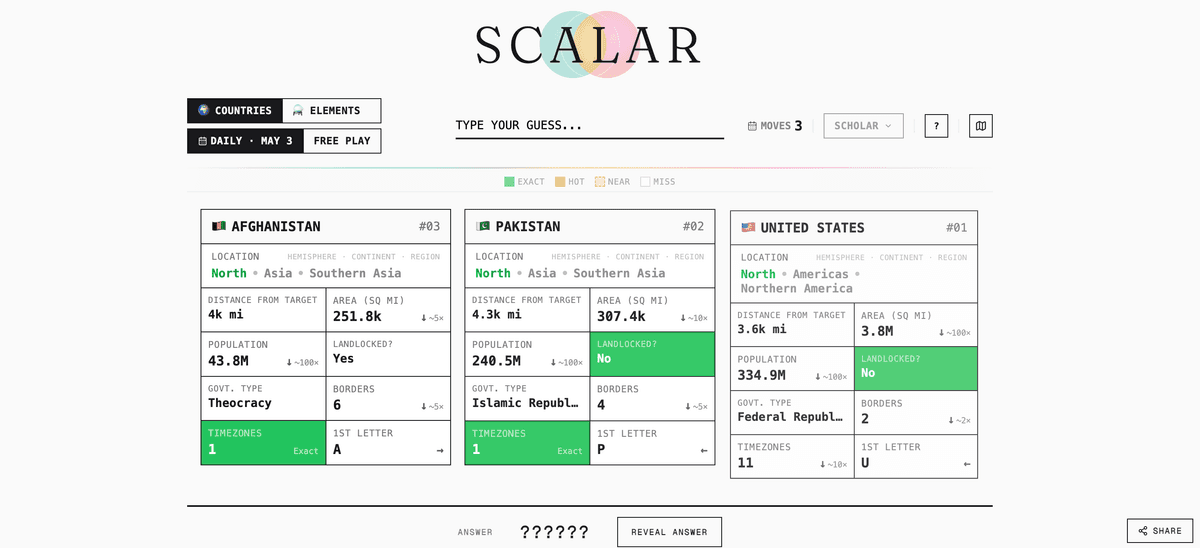
Scalar is a free daily country guessing game at scalargame.com/scalar. It combines the familiar rhythm of a daily guessing game with richer numerical clues: every guess reveals whether the target is larger or smaller, nearer or farther away, and similar or different across several attributes.
The official daily puzzle uses Countries and contributes to the shared four-game Scalargame score. Elements and Cities are optional bonus categories for people who want a different kind of deduction challenge. No account is required.
How the deduction works
After each guess, Scalar compares the guess with the hidden answer field by field. The feedback system supports exact matches, higher-or-lower values, geographic distance, category matches, and overlapping sets such as neighboring countries.
| Feedback | What it tells the player |
|---|---|
| Exact | The attribute matches the answer. |
| Hot | The value or category is very close. |
| Near | The guess is directionally useful but not close. |
| Miss | The attribute is far away or unrelated. |
This means a single country guess can reveal information about continent, subregion, population, area, borders, time zones, and distance from the target. The aim is to combine those signals and solve the country in as few total moves as possible.
Categories
- Countries — the official daily lane, with geographic and demographic clues
- Elements — atomic number, group, period, phase, family, block, and radioactivity
- Cities — country, continent, population, and geographic distance
Scalar has one consistent ruleset. Autocomplete shows up to six suggestions, revealing a hint costs one move, and opening the World Map or Periodic Table costs three moves. There are no difficulty tiers to configure before playing.
Daily and Free Play
Daily mode gives every player the same date-seeded puzzle and contributes Countries results to the official daily set, streak, and leaderboards. Free Play selects a past puzzle date and keeps its own in-progress state without changing official results.
The country map and periodic table are deliberate tradeoffs rather than free answers. They can make a hard puzzle more approachable, but their move cost keeps the low-score challenge intact.
Scoring
Every guess costs one move. Hints and visualizations add their listed move costs. Lower is better inside Scalar, while a normalized Performance Absolute Score (PAS) makes the result comparable with the other Scalargame titles.
PAS = round(1000 × 2^(-(moves - 1) / 7))
The score starts at 1,000 for a one-move solve and halves every seven additional moves. Revealing the answer ends the game with zero PAS.
Product and technical design
Scalar is data-driven: category schemas define how each attribute is compared and displayed, while pure game logic produces feedback without mutating UI state. A slot-based Zustand store preserves Daily and Free Play sessions independently. Category data is split into lazy-loaded files so visitors do not download every dataset up front.
The interface uses a paper-like scientific-journal aesthetic, compact guess cards, keyboard-friendly autocomplete, accessible feedback labels, and responsive visualizations. It runs in modern desktop and mobile browsers and can be installed as a PWA.