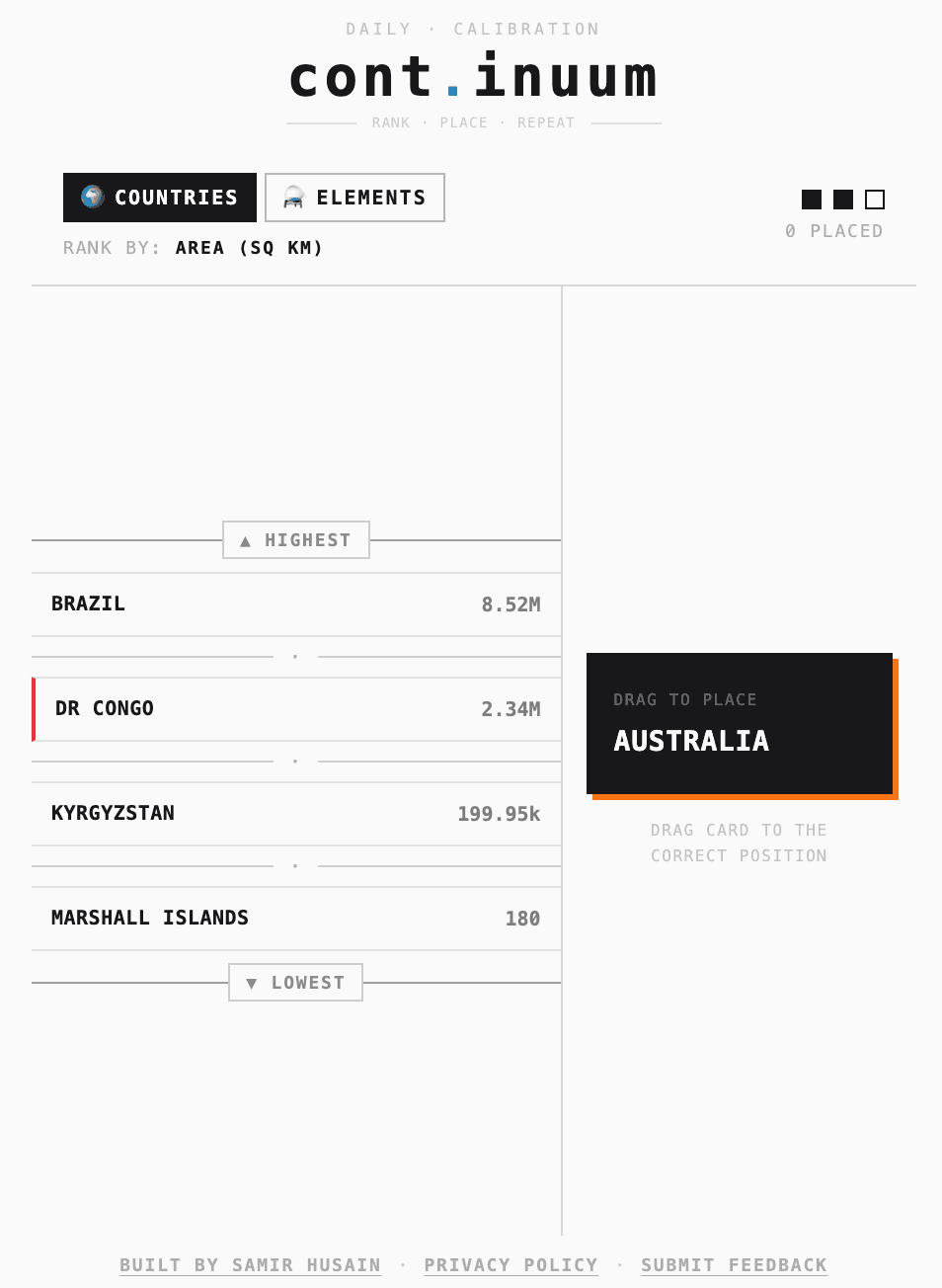
Continuum is a free daily ranking game at scalargame.com/continuum. Instead of asking for an exact number, it asks a more intuitive question: where does one country belong relative to the countries already on the board?
Three reference cards begin in sorted order. A new country appears with its value hidden, and the player drags it into the correct gap. A right placement stays where it was dropped. A wrong placement costs one of three lives, then moves to its true position and becomes a useful reference for the rest of the run.
The daily challenge
The official Daily always uses Countries. A deterministic date seed selects one of three metrics:
- population
- land area
- GDP per capita
Everyone playing on the same local date receives the same metric, starting anchors, and card sequence. The round continues until the third mistake, so the meaningful result is how many countries were placed correctly before the run ended.
Why the card order stays interesting
Continuum does not simply deal random countries. Its fuzzy-bisection system looks for the largest unresolved gap in the ranking and tries to deal a country from the middle of that interval. As the board fills, the decisions become increasingly precise.
For example, an early choice might ask whether one country is broadly more populous than another. Later, the game may ask for the exact order of several countries whose values are much closer together. Wrong answers also improve the board by creating new anchors, so failure generates information instead of only removing a life.
Scoring
The raw score is the number of correct placements. Continuum also converts that result into the shared 0–1,000 PAS scale:
PAS = round(1000 × (1 - exp(-correct / 6)))
Five correct placements earn 565 PAS, ten earn 811, and twenty earn 964. The asymptotic curve rewards every additional correct placement while keeping scores comparable with Scalar, Whenabouts, and Tectonic.
Free Play and Elements
Free Play uses past dates and can switch between Countries and Elements. Element rankings include atomic number, density, and atomic radius. Free Play progress is preserved separately and does not affect the official daily streak or leaderboard result.
Interaction and accessibility
The drag interaction works with mouse and touch, provides visible gap highlighting, and uses motion to show an incorrect card sliding to its true position. Haptic feedback is available on supported devices. The same state changes are announced through accessible text, and reduced-motion preferences replace attention-grabbing animation with a quieter visual response.
Continuum is part of the free Scalargame daily puzzle set and works without registration.